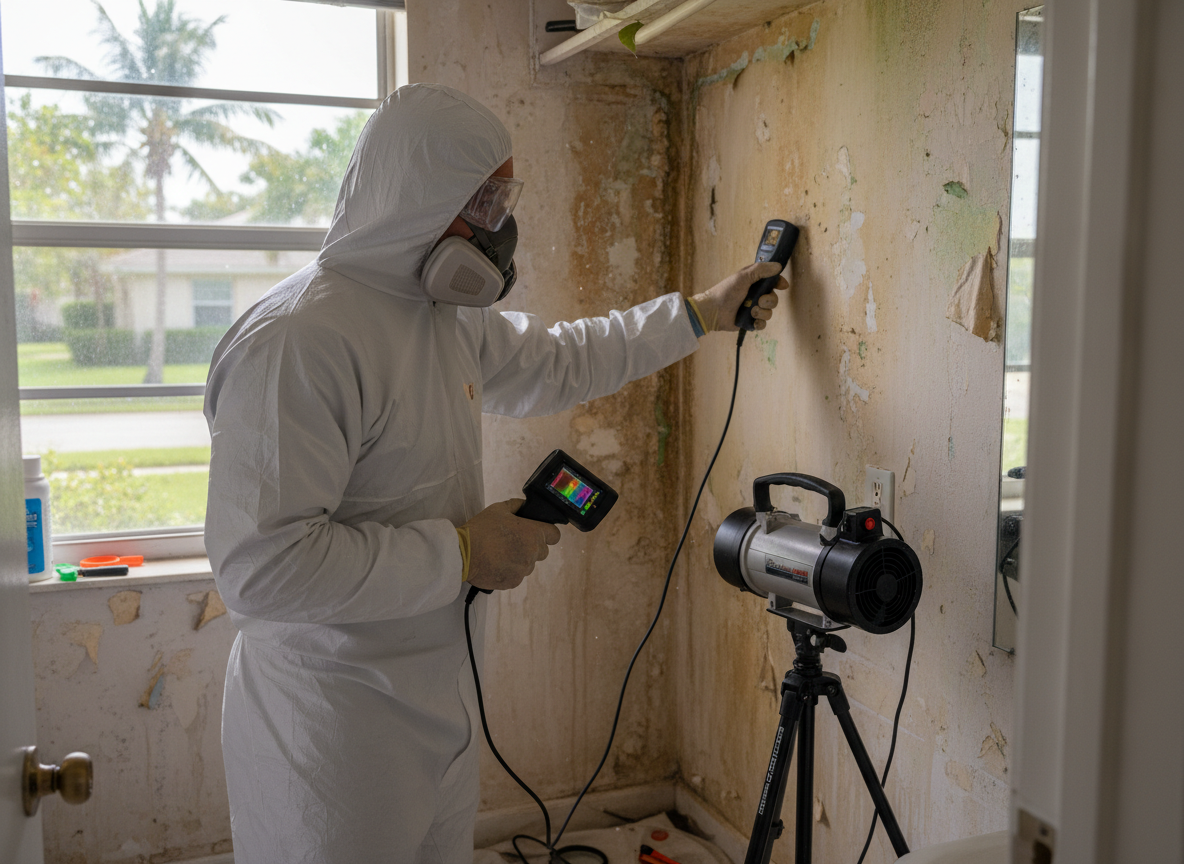
Why Boynton Beach Homeowners Choose Us for a Mold Inspection
The service described on this page is inspection and assessment only. We do not offer removal work here, so the visit is not a sales call for a job this page does not sell. That split matters. An inspection-only visit keeps the findings separate from any decision about removal work. An inspection-only visit keeps the findings about presence, extent and moisture source separate from any decision about what happens next.
Moisture source is the second part of the difference. An inspection that finds growth but not the water feeding it has done half the job. Mold tends to return while the moisture that fed it is still present, so the inspection follows readings back toward the leak, the condensate line, the wet wall cavity or the path that keeps materials damp.
You also receive a written report that you can hand to any remediator you choose, to your insurer, to a property manager or to a buyer's agent. It lists locations, observations, moisture readings, photographs and the likely source. You are not required to use anyone in particular for the next step.
Florida separates these roles in law. Mold assessors and mold remediators are licensed as separate roles through the state's Department of Business and Professional Regulation, and an assessor may not remediate a structure it assessed within the previous 12 months. That separation is why this page is written as an inspection and not as a remediation quote. This page makes no licence claim for this business, and you should ask any company you hire to show its own current state licence for the work it will perform.
Why a Suspected Mold Problem Should Not Be Guessed At
Visible growth is the part you can see: a fuzzy patch on drywall paper, staining on a baseboard, a bubbling paint film, or a dark speckle pattern along a window frame. Hidden growth is the part you cannot see without opening something up. Water that wicks into wall cavities, sits under vinyl or laminate flooring, or collects around a damp subfloor can support growth for weeks before anyone notices a smell. Air-handling equipment is also territory an inspector checks, because condensate pans, drain lines and ductwork can hold moisture. These are places an inspector looks. They are not guaranteed findings, and a clean check in one spot does not clear the whole house.
The moisture source decides whether growth comes back. Growth is a symptom of moisture that stays. If the leak is still active, whether it is a slow drip behind a cabinet or a condensate line that overflows during a humid week, a cleaned surface will be colonised again. That is why this page treats the source as part of the inspection, not an afterthought.
An inspection documents conditions at the time of the visit. It records what is visible, what the moisture readings show, and where sampling is warranted to answer a specific question. It does not establish a health outcome, and it is not a quote for remediation. Anyone with health concerns should speak with a physician. The report describes the building. It does not diagnose anyone.
Proof: How a Mold Inspection Is Scoped and Verified
Every inspection starts with a scope conversation: which rooms are involved, what prompted the call, and where water is known or suspected to have gone. The inspection then follows a verifiable sequence:
- Visual inspection of the areas of concern and the likely moisture paths, including the spaces around the reported water event.
- Moisture readings taken at walls, floors and materials near any suspected growth, logged by location and compared with readings from unaffected areas of the same home.
- Photo documentation of each area as found, before anything is moved or disturbed.
- Air or surface sampling, used only where it answers a real question, such as whether a suspected area differs from a reference area. Sample locations are logged.
- A written report covering locations, readings, observations and the moisture source, with the limits of the inspection stated.
This page does not list equipment brands, laboratory names or credentials. Before booking, ask what the written report will contain and how the findings will be presented to you.
The Scenario Most Boynton Beach Mold Pages Skip: The Inspection That Is Really About the Last Water Event
For example, consider a homeowner in Boynton Beach who has a water heater leak in a guest room. The carpet is pulled, the room runs on fans for three days, and the floor looks dry, so the homeowner assumes the job is finished. Months later, a closet on the shared wall shows dark spotting and a faint smell. Nothing on the surface suggests a bigger problem.
The inspection starts in that closet and works outward. The visual check finds staining on the lower drywall and a soft baseboard. Moisture readings inside the wall are elevated, even though the room surface reads dry. Readings taken farther from the closet show how the moisture fades with distance. The readings continue toward the water heater closet and the drain pan below it, which points to the wall cavity as the place where moisture stayed. Fans move air across a surface, but they do not dry a wall cavity that was never opened. The inspector photographs each location before anything is moved, maps the readings against the positions where they were taken, notes the extent of visible growth, and records the likely source with the evidence behind it.
The report then becomes the scope that a remediator works from. It lists each location checked, the readings with their positions, the photographs, and the source the readings point toward, so whoever performs the next step starts from the same evidence rather than from a guess. Remediation itself is a separate engagement, and this page does not perform it. Drying failures like this one are part of the work covered by our water damage restoration service, which explains how moisture is removed and verified after a water event.
Mold Inspections in Boynton Beach, Up Close
Visual Mold Inspection
A visual inspection is a systematic, room-by-room check of the areas linked to the reported problem and the spaces around them. The inspector looks at walls and ceilings near the water event, then moves to the places where moisture tends to hide: closets against exterior or shared walls, cabinets and vanity bases, the space under sinks, the backs of furniture pushed against damp walls, and window frames and trim. Staining, discolouration, bubbling or peeling paint, warped baseboards and soft drywall paper point to where the inspection should dig deeper. Each area is photographed as found, with its location noted, so the photographs can be matched to the written report. A visual check cannot see inside a wall, which is why moisture mapping follows. Visual findings are recorded as observations, not conclusions, until they are read alongside the readings and the source.
Moisture Mapping Around Suspected Growth
Moisture mapping uses handheld moisture meters to take readings at walls, floors and materials near suspected growth. Each reading is logged by position, so a reading taken on a closet wall can be compared with a reference reading from a dry area of the same home. The aim is to find where moisture is elevated and how that pattern changes with distance from the affected area. The readings are then traced back toward the source. Common paths include a supply line or drain under a sink, a water heater and its drain pan, an air handler's condensate line, and plumbing runs inside a chase or behind a tub surround. The source finding goes into the report with the readings that support it, because growth left without its moisture source is likely to return.
Mold Testing and Sampling
Sampling is used when it answers a question visual inspection and moisture readings cannot. Examples include whether a suspected area differs from a reference area, or whether a homeowner needs a documented answer for a lease, an insurer or a sale. Air and surface samples are collected at logged locations and handled as evidence, with locations, conditions recorded alongside each one. Results are read with the visual and moisture findings and never as a standalone verdict. A single sample is a snapshot. Air samples depend on conditions on the day sampled, and a surface sample reflects only the material it came from. Sampling does not replace the search for the moisture source, and it does not establish what health effects, if any, a person may experience. Where sampling will not answer the question, the report says so and relies on visual and moisture findings instead.
The Inspection Report and What Happens Next
The written report is the main deliverable. It lists the locations checked, what was observed in each, moisture readings with their positions, photographs, any sampling locations and results, and the likely moisture source with its supporting evidence. It also states what the inspection did not cover. Homeowners typically use the report to decide on next steps, to share with a remediator who will quote the work, and to share with an insurer or property manager. Under Florida's separation of roles, the assessor who wrote the report may not remediate the structure it assessed within the previous 12 months, so remediation is a separate engagement with a separate provider. Re-inspection after any remediation is a further verification step, independent of the remediation work, and it is not part of the service described on this page.
Mold Inspection Questions Boynton Beach Homeowners Ask
Do you need a license to remove mold in Florida?
Yes, for remediation work. Florida licenses mold assessors and mold remediators as separate roles through the Department of Business and Professional Regulation. Removal is remediation work, and it is licensed separately from assessment. This business does not claim any mold license on this page, so ask any company you consider to show its current state licence for the role it will perform.
Can black mold be fully remediated?
An inspection can establish where growth is visible, how far it extends in the areas checked, and what moisture source is feeding it. It cannot promise that any remediation will remove every trace, because the result depends on the work performed and on whether the moisture has been stopped. This page does not promise remediation results and does not sell remediation. Colour alone does not identify a species, so the report describes what was seen and what any sampling showed.
How do I get certified in mold remediation?
Remediation credentials come through the state licensing route for remediators, not through an inspection page. This business claims no certification on this page. If you want to pursue remediation work yourself, confirm the current requirements directly with the state licensing board.
How do I inspect my house for mold?
Start with the checks you can make yourself. Look and smell in closets, under sinks, behind furniture against exterior walls, around window frames, and along the edges of flooring where you can see them. Note any staining, bubbling paint, musty odour or recent leak, and watch for persistent humidity. These checks help you decide whether to call someone. A professional inspection adds moisture meter readings inside materials, controlled access to wall cavities and equipment areas where needed, photo documentation and a written report. A clean look is not proof of a clean house, because moisture inside walls cannot be seen.
How much does a mold inspection cost in Boynton Beach?
The cost depends on the factors that set the scope of the work: how many areas are checked, whether wall or ceiling access is needed, whether sampling is warranted to answer a specific question, how much access the property requires, and what kind of written report you ask for. Ask for the scope in writing before booking so you can compare it with what is actually being checked.
To talk through what you have seen, including the smell, the spotting and any past water event, call (561) 639-0725. Contact details are also on our contact page.