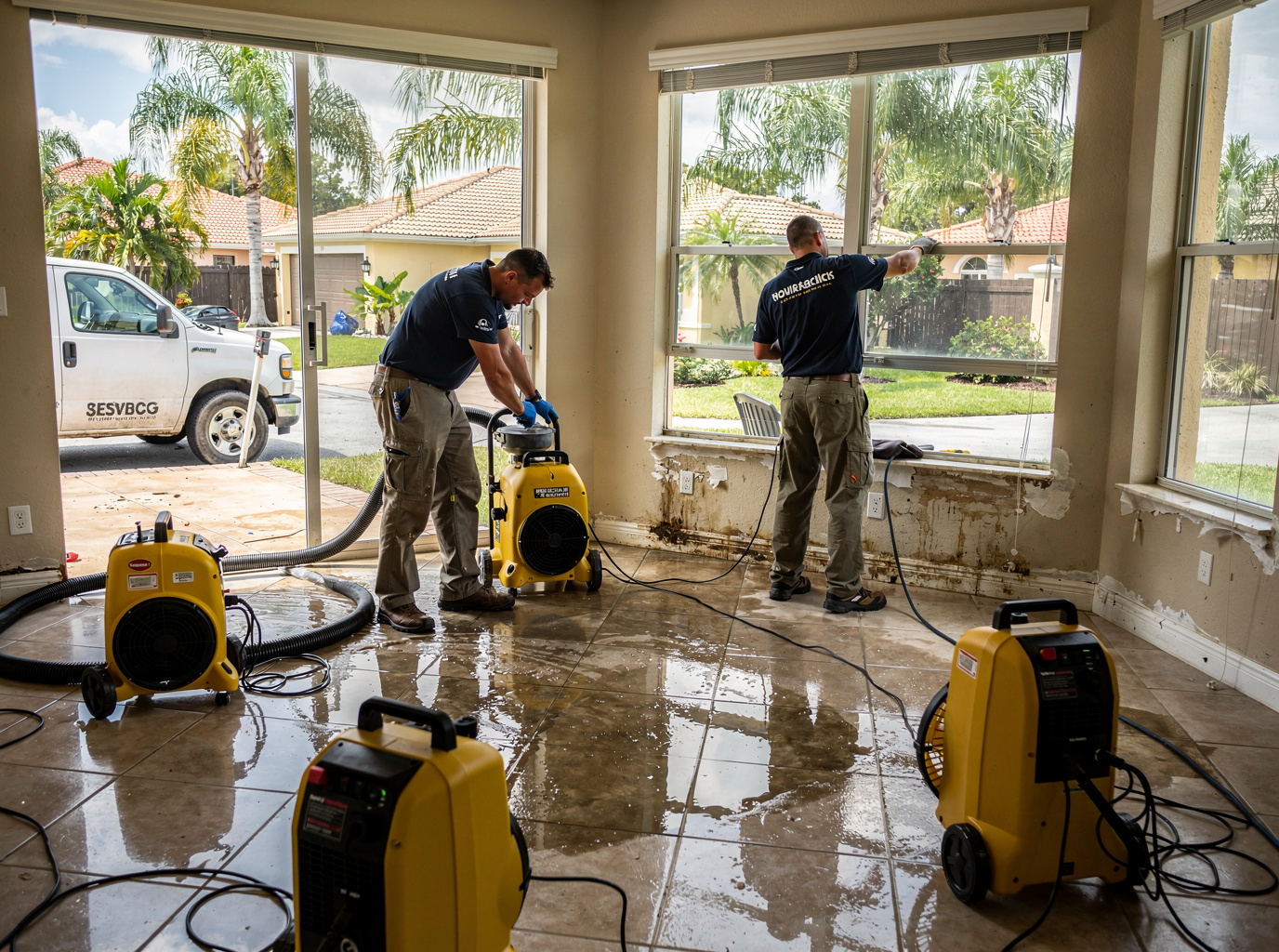
Water damage restoration in Greenacres often starts somewhere other than the coast. Greenacres sits west of Boynton Beach in Palm Beach County, and its calls tend to involve water that arrives through a pipe, an appliance, an air conditioner drain line, or heavy rain that finds a weak point in the roof edge or a doorway. The source is usually on the property itself, and the damage often starts small. Our team serves Greenacres from our Boynton Beach base as part of the same county service area. If water is in your home now, call (561) 639-0725.
Water Damage in Greenacres: The Local Picture
The Inland Water Profile in Greenacres
Greenacres is an incorporated city in Palm Beach County, and it sits inland, away from the coast. That location shapes how water reaches homes. Palm Beach County's wet season and hurricane season overlap in summer and autumn, and during those months intense rainfall can test how well a property sheds water. In low, flat parts of an inland city, rain has fewer natural routes to run off, so standing water can sit against foundations and in landscaped beds longer than homeowners expect. When that water finds an entry point such as a door threshold, a garage sill, a window seal or a gap at the roof edge, the result inside is wet flooring, wet drywall and moisture trapped in wall cavities. Our crews look first at where the water entered, because a rain-driven intrusion needs the outside path closed as well as the inside cleaned up.
The Year-Round Plumbing Baseline
Rain is only part of the picture. Plumbing and appliance failures happen in Greenacres year-round, and they make up a steady share of water damage calls in any season. The common sources follow a familiar pattern. A water heater develops a leak at the tank or the drain valve. A supply line behind a toilet or under a sink splits or loosens at a fitting. A washing machine hose bursts while nobody is home. A dishwasher or ice maker line seeps into the subfloor. An air conditioner condensate line clogs and overflows into a closet or ceiling below the air handler. Florida heat and humidity keep these systems working hard most of the year, and an overflow can go unnoticed for days. A leak running quietly inside a wall often shows up first as a soft floor, a stained baseboard or a musty smell.
How an Inland Drying Job Is Scoped
Every water damage job begins with the same sequence, whether the water came from a rain-soaked wall or a failed supply line. First, the source is identified and stopped, because drying while water still flows wastes time and equipment. Second, standing water is extracted and pumped out, and wet materials are photographed as found. Third, the crew takes moisture readings across floors, walls and subfloors and maps the wet zones so the drying plan targets where water actually sits. Fourth, dehumidifiers and air movers are placed to suit each room, and readings are logged on a schedule until materials approach dry reference levels. Finally, the crew verifies the result with readings before the job is closed. Materials that can be dried are dried in place. Materials that cannot be saved are logged with the reasoning, so the homeowner and any insurer can see why.
Permits in Greenacres
Permit rules for repair work depend on the jurisdiction where a property sits, and Greenacres is its own incorporated city with its own local government. The specific permitting requirements, forms and process steps for Greenacres addresses are not confirmed on this page, and we do not assume that rules from a neighbouring city apply here. Permits, where required, are confirmed for the property's jurisdiction before permitted work is scoped. In practice, the first conversation about a Greenacres job covers the property address, the extent of the damage, and whether structural, electrical or building work is likely to follow the drying stage. If a permit question comes up, we will tell you what we know, what we have not verified, and where the question should be checked with the local government. We would rather flag an open question than guess at a rule that could change your repair schedule.
Water Damage Services in Greenacres
Water Damage Restoration
Our water damage restoration service covers the full job, from the first call to the final dry check. The work includes water extraction and removal, leak detection to find the source, structural drying with dehumidification, moisture mapping, and documentation for your records. For Greenacres homes, the service is built around the inland patterns described above, whether the water came through a roof edge after a heavy storm or from a failed supply line behind a wall. Each stage is recorded so you know what was done and why. You can read the full process on our water damage restoration page.
Mold Inspections
If water has sat in a Greenacres home long enough to produce a musty smell or dark staining, a mold inspection establishes whether growth is present, how far it extends, and which moisture source may have fed it. The inspection produces a written picture of the findings, which is the starting point for deciding what happens next. This service covers inspection and assessment only, so it is a separate step from any repair work that follows. You can learn more on our mold inspections page.
Why Greenacres Homeowners Choose Us
Greenacres homeowners get the same documented, source-first process from our Boynton Beach base, within the same county service run. Our office is at 503 E Boynton Beach Blvd in Boynton Beach. Every customer in our service area receives the same documented process, with no separate or reduced standard for inland calls. We start with the source, so the crew looks for the cause of the water before it looks at the damage the water left behind. Every stage is recorded, from photographs of conditions as found to the moisture readings that show when materials are drying. That record is useful whether you are managing the repair yourself, working with a contractor, or sharing the file with an insurer. We do not promise outcomes we cannot control. We document what we find and what we do, and we explain the reasons behind each step. If you want to talk through a Greenacres job, call (561) 639-0725.
Why Water Damage in Greenacres Should Not Wait
Waiting lets moisture spread inside a Greenacres home. Water does not stop moving because a home has been closed up for the day. Once it soaks into flooring, drywall, insulation or subfloor, it begins to change the materials it touches. Wood swells and softens, adhesives lose their grip, and paper-faced drywall loses strength. Moisture trapped inside a wall or under a floor can keep materials damp long after the visible water is gone, and that hidden dampness gives mold room to start. In Greenacres, the wet season and hurricane season overlap in summer and autumn, so a leak that is already open can be joined by fresh rain entering the same weak point. A roof edge that admitted a little water during one storm can admit much more during the next, especially if the first episode went undried. A supply line that drips behind a cabinet can keep feeding the same spot for weeks before anyone notices. Early action keeps the affected area smaller and leaves a cleaner record of the water's path. If you see water, a spreading stain, a soft spot underfoot, or a new musty smell, call us at (561) 639-0725 so the source can be checked before it grows.
Water Damage Questions Greenacres Homeowners Ask
Greenacres is inland, so where does its water damage usually come from?
Inland water damage in Greenacres can come from two directions: The first is rain and drainage: heavy storms overwhelm low spots, water pools against foundations, and it finds a way in through doors, window seals, garage thresholds or a damaged roof edge. The second is the home's own plumbing and appliances, including water heaters, supply lines, washing machine hoses, dishwasher and ice maker connections, and air conditioner condensate lines. The rain pattern tends to be seasonal and the plumbing pattern tends to be year-round, so a Greenacres homeowner should check both the outside path and the inside systems after any significant water event.
What should I do while water is still coming in?
Start with safety. If water is near electrical outlets, switches or appliances, avoid standing in it, and shut off power to the affected area at the breaker only if you can do so safely. Next, stop the water at its source if you can, such as closing the valve to a fixture, shutting off the supply to a washing machine or water heater, or turning off the main supply if the source is unclear. Move valuables, furniture and rugs out of the wet area where it is safe to do so. Take photographs and video of the water, the damage and the source before you clean anything up, because that record supports the drying work and any insurance documentation. Then call (561) 639-0725 so the source can be identified and the drying plan started.
How much does water damage restoration cost in Greenacres?
The cost of a water damage job depends on the factors that drive the work rather than on a single fixed number. Those factors include how much area is affected, the category of the water, which materials are wet, how long the water sat before it was addressed, how easily the crew can access the affected space, how many days of drying equipment the job needs, and whether a mold inspection is needed afterward. We explain how each factor affects the scope of the job, so you can see what is driving the work. For a conversation about your specific situation, call (561) 639-0725 and describe what you are seeing.
Do I need a mold inspection after an inland leak?
A mold inspection is worth considering when water has stayed in a home long enough for materials to remain damp, when there is a musty odour, or when staining appears on walls, ceilings, baseboards or flooring after a leak. Inland leaks that come through a wall, under a floor or inside a ceiling cavity are the kind that can stay hidden, so the wet material may not be obvious from the room. An inspection establishes whether growth is present, where it is, how far it extends, and what moisture source fed it. It does not perform remediation, and the findings are the written basis for deciding on any next step.
How do you verify a home is dry without tearing everything out?
Drying verification relies on measurement rather than guesswork. The crew uses moisture meters to take readings across floors, walls and subfloors, and compares the affected materials with readings from unaffected areas of the same home, which serve as a dry reference. Moisture mapping shows where the wet zones sit, so the crew can check those zones specifically rather than opening every wall. Where it helps, thermal imaging can be used as a detection method to show temperature differences that may point to hidden moisture. Readings are logged on a schedule during drying, and the job is closed only when the readings show the materials have reached dry levels. Many materials can be verified in place, which means fewer openings in the walls and floors.
Can you help if the water came through a roof leak during a storm?
Yes, we handle the water and the drying that follow a roof leak. That includes removing standing water, documenting the damage as found, locating the moisture path inside the structure, and drying the affected materials. We do not perform roof repairs, so the roof itself needs to be addressed by a roofing professional. We recommend that the roof be checked and any opening closed as soon as conditions allow, because fresh rain can enter the same weak point. If repair work follows the drying stage, questions about permits are confirmed for the property's jurisdiction before the work is scoped. Call (561) 639-0725 to describe the leak and the damage.
Call About Water Damage in Greenacres
If water is in your Greenacres home right now, or you have found a leak you cannot trace, call (561) 639-0725. Tell us the address, what you are seeing and where the water seems to come from, and we will talk through the next steps with you. You can also visit our contact page for more ways to reach our team.